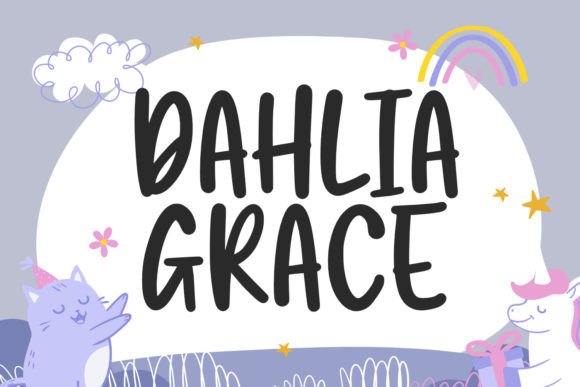
Dahlia Grace Handwritten Display Font for Makers
It was 10:47 p.m., candle wax still smudged on my thumb, and I was tweaking the final label for a new lavender-vanilla soy candle—my third batch this week. The name “Hearth & Petal” needed warmth, personality, and just enough whimsy to stand out in a sea of minimalist serif labels. That’s when I opened Dahlia Grace, typed the shop name, and paused. Instantly, it felt like the font *knew* what the label needed: friendly, unhurried, quietly confident. Dahlia Grace is a cool and friendly handwritten display font. A little bit quirky—but never distracting—and it looked incredibly adept right there on a 2-inch-wide kraft paper sticker.
Dahlia Grace for Wedding Invitations and Elegant Branding
I tested Dahlia Grace across three wedding invitation mockups: digital RSVP cards, letterpress-style printed suites, and a chalkboard-style welcome sign for a backyard ceremony. As a display font, it shines brightest at sizes 24pt and up—especially with generous letter spacing. Its natural flow and subtle bounce give names and dates a personal, hand-lettered charm without sacrificing legibility. Because Dahlia Grace is a handwritten display font, it’s not meant for body text or fine print (no tiny RSVP instructions here), but for “Emma & Leo,” “Saturday, June 15th,” and “Gather Under the Oaks”—yes, absolutely. Pair it with a clean sans serif like Montserrat or Lato for addresses and details, and you’ve got timeless contrast that feels intentional, not accidental.
Dahlia Grace on Candle Labels and Small Product Tags
This is where Dahlia Grace surprised me most—not in grand gestures, but in quiet precision. On 1.5-inch round adhesive labels for tea-light tins, the font held its character down to 14pt when printed at 300 DPI. The key? Avoid tight tracking. Let those letters breathe. I ran test cuts on my Cricut Maker using the OTF version, and every curve and terminal cut cleanly—even the delicate crossbar on the lowercase “e.” As a display font, Dahlia Grace isn’t built for dense ingredient lists or regulatory text, but for short, evocative phrases: “Hand-Poured,” “Small Batch,” “Made With Love.” For boutique packaging, it adds instant handmade credibility—like your product was designed by someone who cares about rhythm, texture, and tone.
Dahlia Grace for Printable Wall Art and Digital Downloads
I created five printable wall art designs—botanical quotes, affirmations, seasonal greetings—and previewed each as PNG thumbnails in my Etsy listing. Dahlia Grace performed beautifully across all formats. Its slight irregularity (a hallmark of authentic handwritten display fonts) gave each design visual warmth and approachability—no sterile perfection, just gentle humanity. Buyers scrolling past dozens of similar prints paused longer on the ones using Dahlia Grace. Why? Because it signals care. It tells them this isn’t mass-produced clip art—it’s a considered design choice. When licensing Dahlia Grace for commercial use (always verify the included license!), you can confidently embed it in PDF templates, SVG bundles, or layered PSD files—as long as you’re not reselling the font files themselves. Bonus: the .OTF includes standard ligatures and stylistic alternates, so “love,” “forever,” and “gather” get subtle, organic connections that elevate even simple phrases.
Dahlia Grace on Tote Bags, Mugs, and Merchandise
I screen-printed Dahlia Grace onto a natural cotton tote using water-based ink—and watched how the font softened just enough at the edges to feel tactile and real, not digital. Same with a ceramic mug: the lowercase “g” and looping “y” added movement and friendliness to “Good Morning, Friend.” As a display font, Dahlia Grace thrives in large-scale applications where its quirks become assets—not flaws. It’s not ideal for embroidery digitizing (too many fine curves), nor for laser-engraved wood signs under 18pt, but for vinyl decals, heat-transfer designs, and direct-to-garment prints? Absolutely. Just remember: always convert to outlines before sending to a printer or cutting machine, and double-check kerning on words like “the” or “with”—some pairs benefit from a tiny nudge.
Dahlia Grace for Seasonal Stickers and Planner Pages
Last December, I designed a set of holiday stickers—“Cozy,” “Joy,” “Merry,” “Snow Day”—and used Dahlia Grace for every headline word. Printed on matte white vinyl at 1.75 inches tall, the font retained its playful energy without blurring or bleeding. On planner inserts, I reserved Dahlia Grace for weekly headers and habit tracker titles—never daily journal lines. That’s the sweet spot for this handwritten display font: moments of emphasis, not endurance. Its charm lies in contrast—so pair it with a crisp, light-weight sans serif (think Poppins Light or Nunito) for subtext and checklists. And yes—it works beautifully in Canva, Silhouette Studio, and Adobe Illustrator alike, as long as you install the full fonts package and confirm OpenType features are enabled.
If you make things by hand—or help others do—the right display font does more than look pretty. It extends your voice, honors your process, and helps customers feel the intention behind your work. Dahlia Grace doesn’t shout. It leans in, smiles, and says, “Let’s make something lovely together.” Whether you're designing greeting cards, packaging for small-batch goods, digital printables, or shop-branded merchandise, Dahlia Grace brings that cool, friendly, quietly quirky presence that makes handmade feel unmistakably human.